
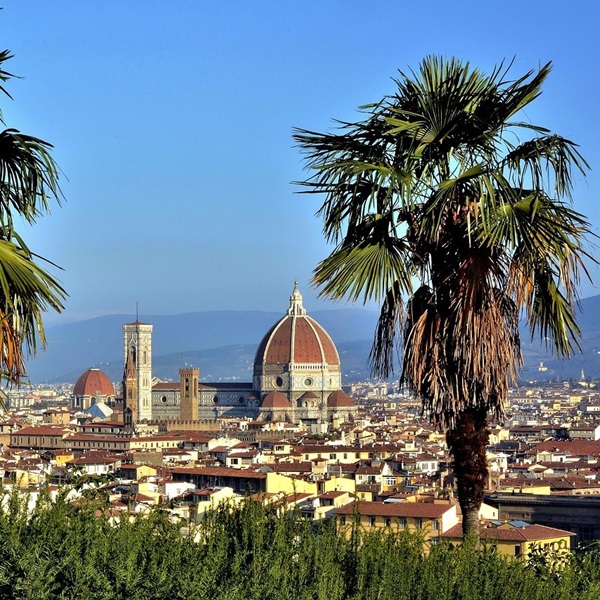
A Traveller’s Guide To What To See And Do In Florence.
Very few cities compare to Florence when it comes to art, culture, history and architecture. The city’s allure is evident at every turn where honey-toned sandstone and pale marble architecture with terracotta roofs create the warm, unmistakably Florentine vista, where the streets curve quietly, gently inspiring you to explore further as the grand piazzas glide into view.
Art lovers, history enthusiasts and curious travellers are each drawn to the graceful charisma of this elegant city, to experience the unique Florentine atmosphere with many returning year after year.
Florence (Firenze) is the capital city of the Tuscany region in north-central Italy. Situated on the Arno River and enveloped by rolling Tuscan hills with Fiesole to the North and the Chianti region to the south, it lies approximately 50 miles west of Pisa. This central location means it is well connected as a major stop for the high-speed trains of the Italian railway system.
The Italian word Florentia, meaning ‘the blooming’, inspired the city’s name which is also known as the City of Lilies. Florence was founded as Florentia by the Romans in 59 BC, and the lily later became its enduring medieval emblem. The city and its architecture are peppered with lily emblems which can be found on everything from business logos to building façades.
The central area of Florence is quite compact and easily walkable with the main attractions all within around 2 square miles.
Journey with us as we discover gems of archaeological history, visit iconic attractions and experience the Renaissance masterpiece that is Florence, Italy.
Itinerary | Day One Of Two
Mention Florence and most people may envisage the famous Duomo with its distinctive, red-tiled dome dominating the skyline; there’s no better place to begin our journey through Florence than at the site of the Duomo;
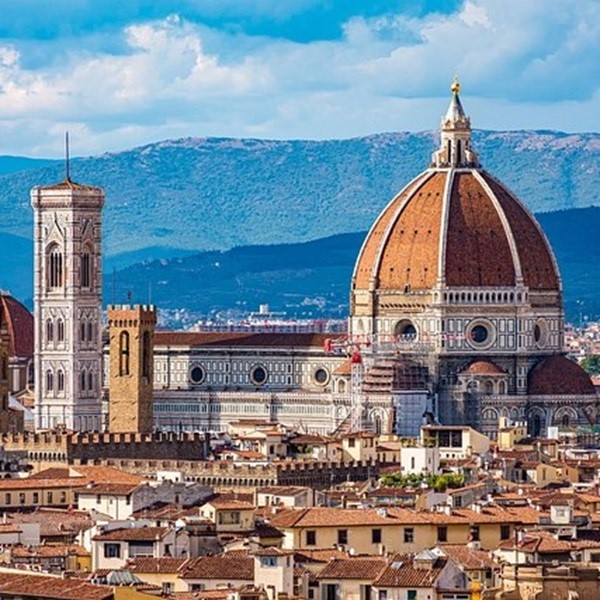
Cathedral of Santa Maria del Fiore
North of the River Arno sits the iconic cathedral, with its unmistakable profile dominating the Firenze skyline. Approaching the cathedral on foot from the surrounding streets, Florence tightens and then releases. The city’s narrow lanes encourage you forward until the space opens and the Duomo rises into view. The white, green, and blush-pink façade appears perfectly positioned and thoughtfully assembled.
Standing in the piazza, the scale becomes quietly overwhelming. The marble panels positioned in careful geometry, while the lantern crowns the dome, swelling above the crowd, vast and perfectly balanced.
Construction of the cathedral began in 1296; the main structure originally designed by Arnolfo di Cambio, the 85-metre-high bell tower was designed by Giotto around 1334 with the main construction finalised around 1359 by Andrea Pisano and Francesco Talenti. With the ambitiously magnificent cathedral structure in place, the task remained to design a roof to cover the huge building which spans 153 metres in places. Without modern day construction methods, this posed a task few could fathom, and the cathedral stood without a roof for decades, until Filippo Brunelleschi solved the engineering challenge in 1420. Brunelleschi proposed a pioneering vision of a self-supporting, double-shell dome which required custom designed apparatus to lift heavy building materials high into the air. Brunelleschi incorporated a herringbone brick pattern into the design to prevent collapse during construction with horizontal stone and iron rings to act like tension bands; combining his architectural knowledge with artistic creativity, he was able to synchronise mathematical proportions and geometry with symmetry and in 1436 his vision was realised and the cathedral, which a decade later was to become Brunelleschi’s final resting place, was complete.
Upon entering the cathedral today, the interior opens suddenly and the sheer size of the construction becomes apparent. The interior is vast and stark compared to the ornate façade. The floor stretches out in patterned marble, set with tomb slabs and the nave is immense, rhythmically divided by huge piers and pointed gothic arches which lift your gaze upwards. Near the entrance hangs a remarkable 15th century clock by Paolo Uccello, which following ancient Italian timekeeping, runs counterclockwise.
Venturing deeper inside and raising your gaze further upwards towards the dome interior, you witness a masterpiece of the Italian Renaissance: Giorgio Vasari’s colossal fresco of the Last Judgement. Begun in 1572 the piece covers over 3000 square metres of the dome interior, depicting angels, demons and damned souls organised into eight sectors, each representing different aspects of the Last Judgement. The fresco was completed after Vasari’s death in 1574 and remains today a breathtaking testament to the theological depth and artistic application of the period.
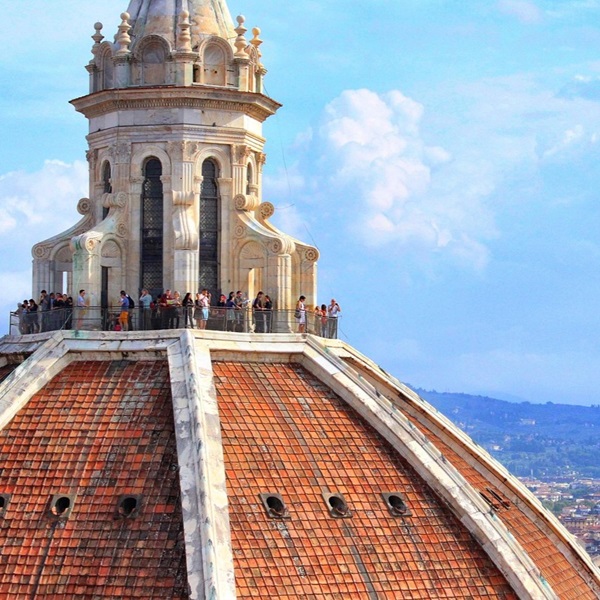
Through a narrow, unassuming doorway, those wishing to climb the Duomo immediately begin their ascent as the stairs abruptly begin. Worn smooth by centuries of footsteps, the cold, stone stairs twist tightly as the air cools and the light dims. Part way up sits a narrow gallery, high above the cathedral floor, giving you opportunity to look down and again appreciate the vastness of the space and scale.
Continuing upwards the staircase takes you through the narrow cavity between the inner and outer shells of the dome. The walls curve inward and you can clearly observe the herringbone brickwork and the low ceiling is within touching distance, you are physically experiencing what was once only Brunelleschi’s vision.
Higher still, the platform beneath Vasari’s Last Judgement offers the emotional intensity that comes with viewing the enormous masterpiece up close, revealing the remarkable detail of expressions and brushstrokes.
The stairs narrow again and grow steeper towards the most challenging part, and the handrails are a welcome aid as you reach the top of the staircase and the viewing platform at the top of the dome, just below the lantern. The 463 steps climbed are more than compensated as the sky majestically opens and the magnificence of the terracotta city spans in front of you, as you are rewarded with breath-taking views over Florence and the Tuscan hills, ingraining an experience which stays with you much after the descent back to the streets below.
Accademia Gallery (Galleria dell’Accademia)
Staying north of the river, we make a 20-minute walk to our next stop at the Accademia Gallery.
Founded in 1784 by Grand Duke Pietro Leopoldo of Tuscany, the gallery is a teaching collection for students of the Academy of Fine Arts. Moving through rooms housing gold-ground religious paintings from 13th – 15th centuries and early Renaissance altarpieces, you then enter the Gallery of Prisoners where Michelangelo’s unfinished pieces appear to struggle free from marble blocks, forever captured in time, halfway between inception and completion. The positioning of pieces throughout the gallery depicts the stages and struggles of Michelangelo’s artistic journey.
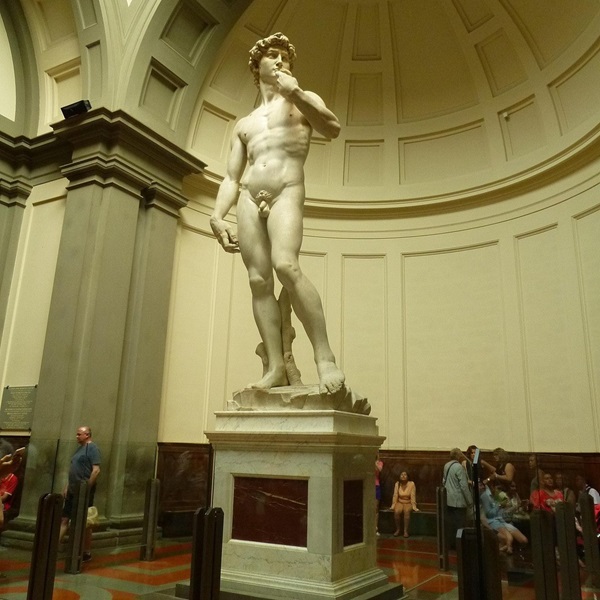
At the far end of the Tribune, a circular skylight pours natural light on to the white marble which commands your attention as you stand before the 5-metre-tall masterpiece that is Michelangelo’s David. Symbolising the defence of freedom and intelligence over brute strength, at close proximity the observer can truly behold the skills and mastery that Michelangelo possessed. Sculpted in 1501 from marble originally discarded by other sculptors as flawed, David offers a different emotional note from each perspective. From the front he is poised, his gaze is focussed and intent. The side view offers the specifics of subtle muscle tones and from the rear perspective the astonishing precision and intricate detail of veins and tendons demonstrate Michelangelo’s immeasurable artistic skill and anatomical mastery.
Whilst David is the centrepiece, the gallery houses many other pieces from the Medici collections and works by Botticini, Uccello and Ghirlandaio. Spending around two hours within the gallery provides enough time to appreciate the works at a steady pace.
Basilica di Santa Croce
A short 10-minute walk from the Accademia Gallery is the Piazza Santa Croce, one of Florence’s most atmospheric squares, framed by cafes, shops and galleries and home to the Basilica di Santa Croce.
The design of the Basilica was intended to be a vast, open space which could accommodate large gatherings for preachings. Once inside, the nave stretches forward as tall, gothic arches rise upwards and light pours through the softly coloured windows whilst the exposed wooden ceiling contrasts with the pale, stone walls. The basilica houses several tombs and memorials of notable figures such as Galileo Galilei, Niccolò Machiavelli and Michelangelo Buonarroti.
Another prize of the work of Filippo Brunelleschi is the Pazzi Chapel within the basilica, perfectly proportioned and defined by geometry with precise mathematical ratios and symmetry, the chapel is a further Renaissance masterpiece.
Venturing beyond the interior of the basilica reveals the peaceful cloisters of green, gentle courtyards and museum spaces illuminating the fascinating history of the basilica and its art.
Allowing 1-2 hours to visit offers insight at a steady pace, giving time to capture photographs, although flashes are not permitted. Also to note, that modest dress is required within the basilica and shoulders and knees should be covered.
Uffizi Gallery
Just 5 minutes from the Basilica di Santa Croce is the remarkable Uffizi Gallery, commissioned in 1560 by Cosimo I de’ Medici, the Grand Duke of Tuscany, the structure was originally the administrative home of local magistrates. However, the influential Medici family who were avid art collectors, utilised the building to house their extraordinary art collection and the gallery was opened to the public in 1765.
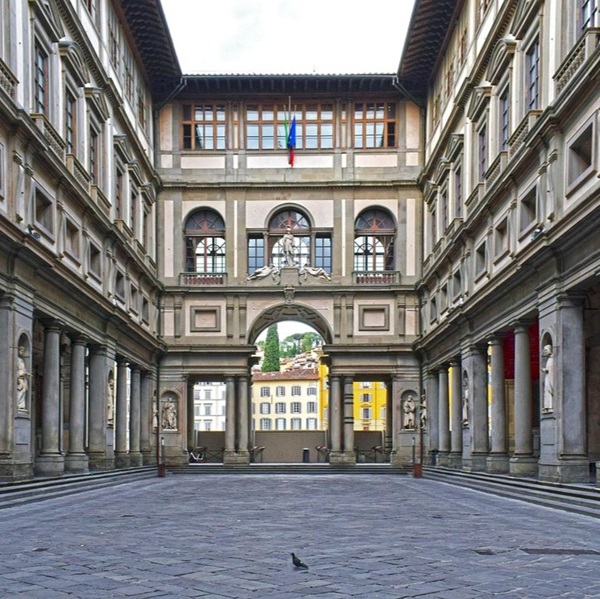
Inside the museum are long corridors with connected rooms and large windows offering natural light which gently illuminates the hanging pieces. The collections are thoughtfully positioned, and the chronology of this arrangement transports the observer through the evolution of the Renaissance Masters and the experimentations of their work.
Works of Sandro Botticelli found in the Uffizi include Primavera, and The Birth Of Venus, a delicate and refined depiction of a mythical beauty.
Early works of Leonardo da Vinci include The Annunciation, and the unfinished Adoration of the Magi offer insight into his early experimentation with movement and shading.
Michelangelo’s Doni Tondo (The Holy Family) bursts with vibrant colour whilst Raphael’s Madonna offer a balanced, harmonious tone, contrasting against the later, dramatic rooms housing Baroque works such as Caravaggio’s Medusa. Travelling through the long corridors of painted ceilings and classical sculptures allows you to appreciate the tone and the significance of the elevated societal position which the Medici family wished to portray.
Food and drink are not permitted within the gallery, but you will find a café located on the top floor serving refreshments. Original forms of identification, such as a passport may be requested upon entry.
Palazzo Vecchio
We bring our first day of discovery to a close at the Palazzo Vecchio, the historic town hall of Florence, symbolising civic pride and the political ambitions of 13th century Florence.
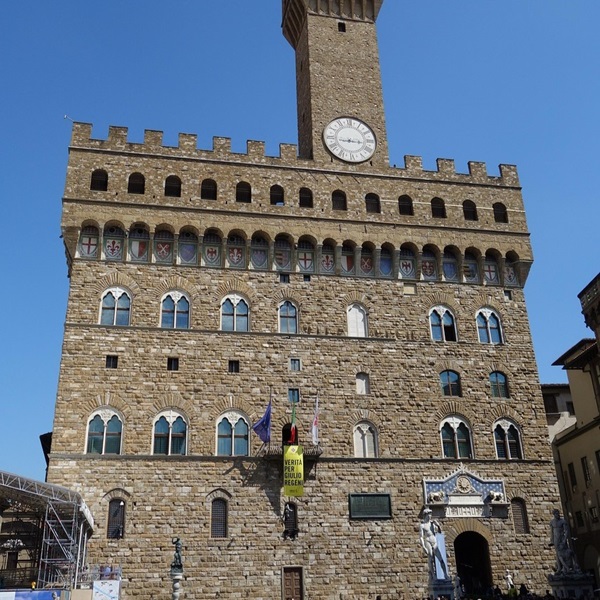
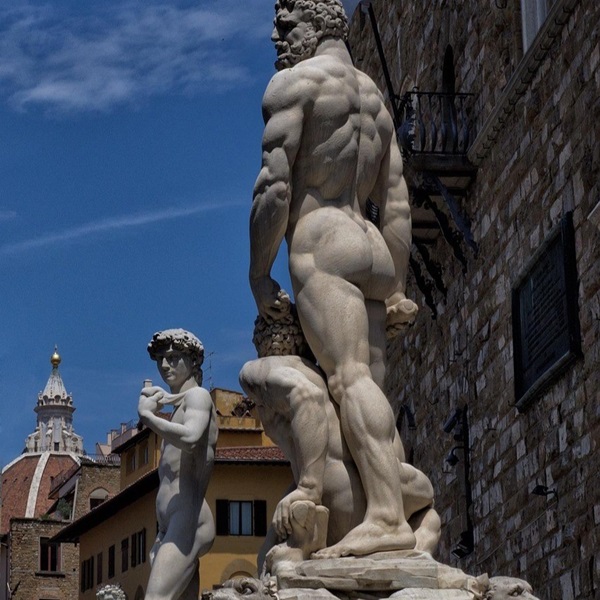
The palace proudly stands within the Piazza della Signoria, a square exuding history like an open-air museum. Whilst Michelangelo’s David once stood at the entrance, before being moved to the Accademia Gallery, today you’ll see a replica of the famous masterpiece alongside Baccio Bandinelli’s Hercules and Cacus.
The Palazzo Vecchio is constructed of solid stonework, topped with battlements and defensives arches, reminders of a city once shaped by political unrest.
Within the palace, the monumental 15th century Salone dei Cinquecento (The Hall of the Five Hundred) stretches nearly 55 metres long with towering ceilings and is adorned with huge battle frescoes along the walls celebrating military victories, and the ceiling gleams with gilded panels and intricate paintings.
The upper floors of the Apartments of the Medici are richly decorated with painted ceilings and family portraits.
The clock tower, which stands at approximately 95 metres, was designed by Arnolfo di Cambio, from whom the tower takes its name, it contains two small prison cells which once held Cosimo de’ Medici The Elder, the de facto first ruler of Florence and Girolamo Savonarola the Dominican friar who was hanged and burned in the Piazza della Signoria in 1498. Climbing the Torre di Arnolfo takes you along steep, narrow, winding stone staircases and defensive passages. Along the 223 steps there are a few small landings where you can pause and view the fortress-like crenelations up close and appreciate the thickness of the stone walls. Through the slit-like windows you look over the Piazza della Signoria and sense the weight of authority conveyed by the impressive and imposing palace.
Steadily heading a few streets southeast of the Piazza della Signoria we bring our first day to a close at one of the classic restaurants along Via Lambertesca. Chosen for its location away from the main tourist trail, and firm favourite with the locals, the eateries here offer a vibrant, authentic feel without the hustle and bustle. Here you find a range of food offerings from pizzas and schiacciata breads to traditional Tuscan dining such as ribollita soups, pici pasta and bistecca alla fiorentina (Florentine steak) and of course regional Chianti and Brunello wines. A perfect way to relax, savour the local cuisine and recall the wonders of the day whilst anticipating the discoveries of the second leg of our Firenze journey.
Itinerary | Day two of two
Ponte Vecchio
The first day of our journey through Florence took in some of the iconic attractions north of the River Arno, our second day sees us spending time to the south, in the Oltrarno District. To get there, we cross the water via the famous Ponte Vecchio, one of the most photographed bridges and recognisable landmarks in Italy.
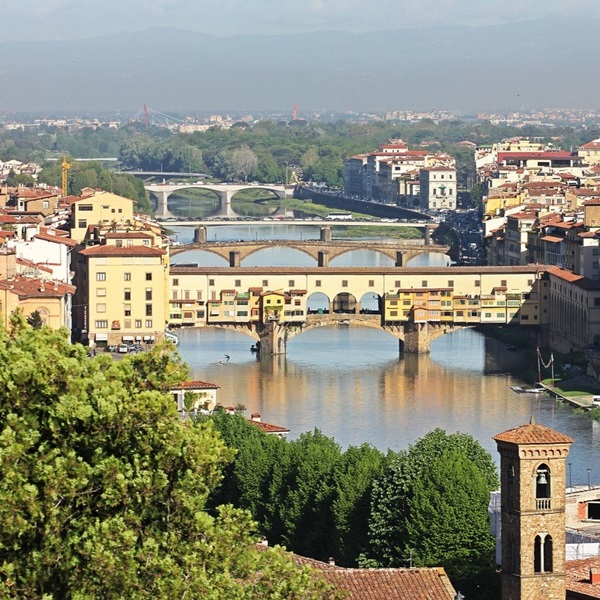
It is thought that the bridge was originally built in 996 AD and is regarded as the oldest bridge in Florence, it has seen a number of restorations in its time. The original Ponte Vecchio (meaning ‘Old Bridge’) was rebuilt in 1345 after earlier versions were destroyed by floods. The distinctive three, wide arches were innovations of their time, a design which allowed water to flow more freely beneath and so ensuring the longevity of the most recent structure.
Spanning the breadth of the river this ancient crossing of warm stone arches is peppered with timbered shops which extend outwards on wooden brackets giving the bridge its unmistakable top-heavy appearance. Lining either side, these shops originally housed fish mongers and meat traders but in 1593 Ferdinando I de’ Medici proclaimed that only jewellers and goldsmiths were permitted to trade here. It is thought that this was a decision originally made to improve the smell but had the additional benefit of elevating the prestige of the Ponte Vecchio; today you will find handmade jewellery stores and world renowned artisan goldsmiths.
Paying close attention to the small windows running the length of the upper levels of the bridge, you recognise that these are the windows of the Vasari Corridor, an enclosed and elevated walkway built by Giorgio Vasari in 1565. The corridor was commissioned by Cosimo I de’ Medici and connects the Pitti Palace to the Palazzo Vecchio and was used by the Medici family to travel privately and safely away from the general public.
One of the most popular photograph locations in the city lies at the centre of the bridge, from here you can see the eastern and western views stretching along the river as the reflections of the elegant bank-side buildings shimmer in the water gliding below.
Pitti Palace
After crossing the Ponte Vecchio and continuing straight ahead, along Via de’ Guicciardini into the quieter Oltrarno District a few short minutes brings you to a broad, open square dominated by the majestic Pitti Palace.
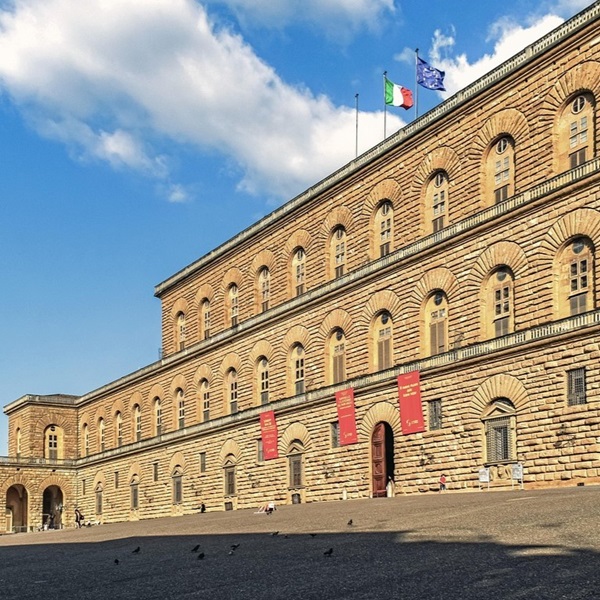
Building of the palace began in 1458 for a wealthy banker, Luca Pitti and it was purchased by the Medici family in 1549 after which it became the Medici’s main residence.
The palace was built for grandeur as the huge blocks of stone, fortress like appearance and the vastness of the building spanning the square commands your attention, whilst the repeating arched windows demonstrate the rhythmical symmetry of the Renaissance.
Within the palace, the Palatine Gallery feels like a private royal apartment of silk covered walls, floor to ceiling paintings and gilded borders. Throughout the royal apartments are spectacular chandeliers, canopied beds, rich fabrics and polished floors.
To the rear of the palace are the stunning Boboli Gardens, featuring sculptures and fountains. These manicured grounds of geometric paths, hillside grottos and terraces offer spectacular views overlooking the city. A visit to Pitti Palace offers a glimpse into the history of Florence and it’s ruling families, their lifestyles and accompanying grand theatre and opulence of the wealthy of the time.
Visiting both the palace and the gardens offers the fullest experience and comfortable shoes are recommended as uphill walking is required to fully explore the gardens.
Cappella Brancacci
Staying within the Oltrarno District, we head towards the lively Piazza Santo Spirito, lined with cafes, perfect for a spot of lunch and people watching before moving onwards to Via di Santa Monaca. Our walk takes us through narrow medieval streets with small, arched, traditional wine windows and finally to Piazza del Carmine the home of the Church of Santa Maria del Carmine and Cappella Brancacci (The Brancacci Chapel).
Tucked inside the Church of Santa Maria del Carmine is the seemingly unassuming, small chapel, Cappella Brancacci, however once inside, the chapel is entirely frescoed with horizontally positioned panels of paintings covering the walls.
The Tribute Money fresco by Masaccio was painted in the 1420’s and is considered among the artist’s best work, depicting elements of the Gospel of Matthew. The piece projects emotional realism and uses the linear perspectives of the architecture which project its transformational influence upon the art world. Another breathtaking piece from Masaccio is the Expulsion from the Garden of Eden, showing Adam and Eve leaving Paradise.
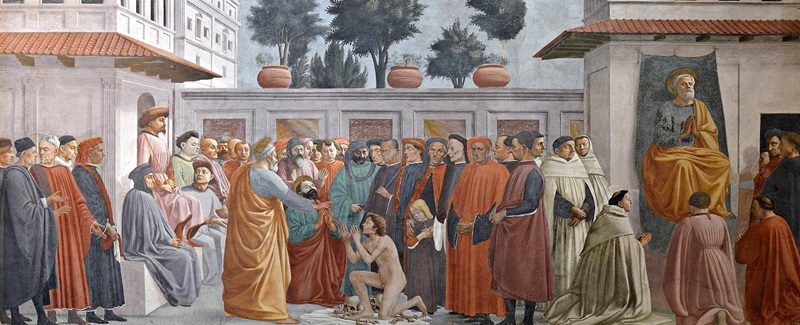
Standing before Masaccios’ Resurrection of the Son of Theophilus fresco, painted in the 1420’s feels emotional. You immediately feel the scale of the near life-sized figures and the architecture seems to recede into space, giving presence and dimension to the fresco figures.
The Chapel and its frescoes were studied by young painters, including Michelangelo and were highly influential in the works of the famous Renaissance artists that were to follow.
Allowing around and hour to visit the chapel is sufficient as entry is timed with controlled visitor numbers.
Piazzale Michelangelo
The grand finale of our Firenze tour takes us to the Piazzale Michelangelo.
Approaching on foot from the Oltrarno district, the buzz of traffic in the streets is gently replaced by the softened sound of footsteps on stone and the hum of the occasional scooter as the narrow streets tilt gently upwards, past shuttered windows and stone walls dotted with tiny shrines. Rising between the buildings and moss-covered walls, worn steps ascend as the city emerges into view.
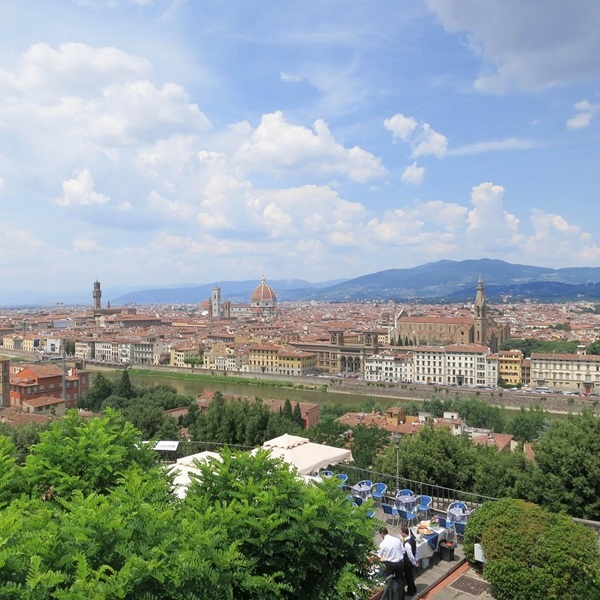
The Piazzale Michelangelo is the viewpoint at which Florence reveals itself, overlooking Florence’s historic centre the panoramic square is set on a hill, a stage intentionally designed to admire the city.
Designed by Giuseppe Poggi and built in 1869, the terrace offers stunning views of the capital’s landmarks, flanked by terracotta rooftops and the Tuscan hills touching the horizon.
In honour of Michelangelo, in the piazza centre stands a bronze of Michelangelo’s David surrounded by replicas of statues from the Medici Chapels.
Whilst the Piazzale Michelangelo is a popular spot, it doesn’t feel crowded thanks to its design of low stone walls, wide open terrace and balanced symmetry.
Florentines gather at sunset as the Duomo radiates golden-honey hues and the air measures the tempo of life as the church bells gently ring and people slow to admire the beauty of Florence as the city lights begin to glow.
Relaxing on the terrace of the historic La Loggia restaurant with a Chianti, taking in the sweeping views and watching The Arno glisten and wind through the city as the sun begins to dip, is the perfect way to toast our inspiring and most memorable journey through Florence.
Flights and getting around
- Florence Peretola Airport (FLR) — around 20 minutes from the city center, ideal for exploring central Tuscany.
- Flight time approximately 2 hours
Where to stay in Florence
Choosing where to stay can make a big difference to how much you enjoy your time in the city, especially if you’re packing in iconic attractions like the Duomo, Uffizi Gallery, Accademia, Santa Croce and Ponte Vecchio. The historic centre (Centro Storico) is the obvious heart of the city: compact, walkable and surrounded by centuries-old streets, elegant piazzas and superb restaurants. Staying here means you can wander out of your door each morning and find yourself at the Cathedral of Santa Maria del Fiore, Piazza della Signoria and the Uffizi within minutes, without relying on buses or taxis. Many hotels and guesthouses in this area are set in beautifully restored historic buildings with characteristic stone façades, wood-beam ceilings and balconies overlooking narrow cobblestone streets.
For those who prefer a slightly quieter base with equally easy access, the Oltrarno district (south of the Arno River) is a fantastic choice. This neighbourhood has a more local feel while still placing you within easy walking distance of Ponte Vecchio, Palazzo Pitti, Boboli Gardens, the Brancacci Chapel and the lively Piazza Santo Spirito, perfect for an evening aperitivo after a day of sightseeing. Accommodation here tends to blend boutique charm with artisan character, from stylish B&Bs to elegant townhouse hotels, many with views across the river back toward the Duomo and city skyline. Regardless of budget, both areas put Florence’s best attractions, plus an abundance of cafes, wine bars and gelaterie, right on your doorstep, allowing you to savour the Renaissance capital at your own pace.

Annia Rosetti – travel writer for Palma Coco Travel 2026.

 PalmaCoco Travel